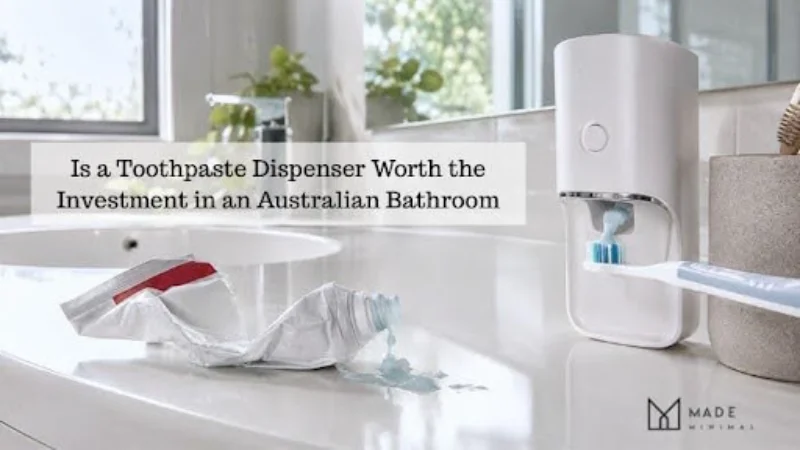
A toothpaste dispenser isn’t the first bathroom accessory most people think about. But if you’ve ever squeezed a near-empty tube at 6 am or scraped dried paste off the counter, you’ll notice that daily mess has a price tag.
And it only gets worse with kids, who tend to pile way too much toothpaste onto one brush.
All of that waste raises one question: Does spending $20–$40 upfront on a dispenser save you anything over time? Our team at Made Minimal tested a few across our own bathrooms and compared the numbers. A family of four wastes roughly $20–$30 in toothpaste a year, about the same price as the unit itself.
So we’re covering the upfront cost, the waste you’re paying for without realizing, and how a dispenser fits a minimalist bathroom. Your bathroom doesn’t need more accessories, just the right ones.
What a Toothpaste Dispenser Actually Costs Upfront
A countertop toothpaste dispenser in Australia typically costs between $15 and $45, though the price depends on the build, the brand, and whether it’s manual or spring-loaded. Most households only need a basic manual model, which sits at the lower end of that range.
That said, wall-mounted and automatic versions can push closer to $60. We’ve compared a fair few bathroom accessories brands in Australia, and benchtop models consistently come out ahead for everyday use. A manual model at half the price dispenses paste just as accurately as a motorised unit.
For context, a single replacement soap dispenser or toothbrush holder costs roughly the same. So a toothpaste dispenser isn’t an added line in your bathroom budget. It replaces something you’re already buying.
Now, let’s look at what you’re actually losing without one.
How Much Toothpaste and Money You Waste Without One
Most households throw out toothpaste tubes with 10–15% of the product still trapped inside (you know the struggle with a near-flat tube on a Monday morning). As we mentioned, for a family of four buying a fresh tube every three to four weeks, that leftover paste costs roughly $20–$30 a year.
Believe it or not, that’s about the same price as the dispenser itself. So within 12 months, the cost of wasted toothpaste alone covers what you paid upfront. And your kids won’t squeeze out half the tube in one go either, because a dispenser controls how much comes out per press.
In any bathroom with young children, that portion control is where the real value sits. With the maths covered, the next step is knowing what your money actually gets you.
Key Features That Justify the Price Tag
The best part about a decent toothpaste dispenser is it handles portion control, mess, and compatibility in one unit. Any parent who’s handed a tube to a five-year-old knows the cleanup that follows.
These are the features worth paying for.
- Controlled Portions Per Press: Each press releases a set amount of paste, so your kids aren’t loading up the toothbrush. Healthdirect recommends a pea-sized amount of fluoride toothpaste, and a dispenser gets you close to that per brush.
- Sealed Nozzle Design: The nozzle stays closed between uses, so toothpaste won’t dry out or crust around the cap (no one wants that crusty cap situation). You’ll spend less time wiping down your bathroom accessories too.
- Standard Tube Compatibility: Most models sold in Australia fit common tube sizes from Colgate, Oral-B, and Sensodyne.
Between fewer wasted tubes, less countertop grime, and no adapter costs, a $20–$40 dispenser earns back its price within months.
Bathroom Accessories That Actually Earn Their Bathroom Space
Every item on your bathroom counter should earn its spot. So does a toothpaste dispenser pull its weight, or does it just add to the clutter? Frankly, if something just sits there collecting grime, it’s gone.
In this case, a dispenser replaces three things you’re already dealing with: the tube itself, the loose cap, and the sticky residue on the shelf. That’s three clutter sources rolled into one compact unit that sits upright on the benchtop. We swapped one onto our own vanity for a few weeks, and the daily wipe-down barely felt like a chore after the first week.
It’s also less to shift when you’re cleaning around your soap dispenser, towel holder, and storage containers.
Now that the practical case is covered, the question is whether it fits the aesthetic too.
Why It Belongs in a Minimalist Bathroom
The whole idea relies on items that serve a clear function without adding visual noise. This is how the two options compare side by side.
| Crinkled Tube | Countertop Dispenser | |
| Appearance | Wrinkled, squeezed, changes shape daily | Uniform, upright, contemporary look |
| Style Match | Clashes with coordinated bathroom accessories | Blends with soap dispensers and holders |
| Visual Consistency | Dried paste around the cap, label peeling | Clean lines, sealed nozzle, no visible mess |
You notice the difference the moment your countertop has a uniform lineup instead of one odd item out (and yes, guests notice it too). A dispenser matches the same design logic as your towel rack, mirror, and soap pump. In a minimalist bathroom, every piece on the counter should feel intentional, and this one does.
How a Toothpaste Dispenser Completes a Simple Bathroom
For under $50, you get a cleaner counter, less wasted toothpaste, and one fewer item to wipe down each week. A toothpaste dispenser won’t reinvent your whole bathroom, but it will still earn its place among your everyday bathroom accessories.
If you’re putting together a simple bathroom that’s functional and easy to maintain, this is one of the smaller investments that pays for itself within the year. Browse the full range of bathroom accessories online at Made Minimal to find a style that suits your space.